Knowing whether someone is an employee or an independent contractor is a key decision in your construction business. It does not depend on what the contract says, but on how the work is done in real life.
In California the rules are stricter than in other states. One mistake can cost you thousands of dollars. This guide is ODC's reference on worker classification.
In short
- What counts is the real working relationship, not the 1099 form they signed.
- California uses the ABC test: a worker is presumed to be an employee.
- In construction, someone who works without a license when a license is required is presumed to be an employee (Labor Code 2750.5).
- A licensed subcontractor must meet the requirements of Labor Code 2781.
- Intentionally misclassifying can cost $5,000 to $25,000 per violation.
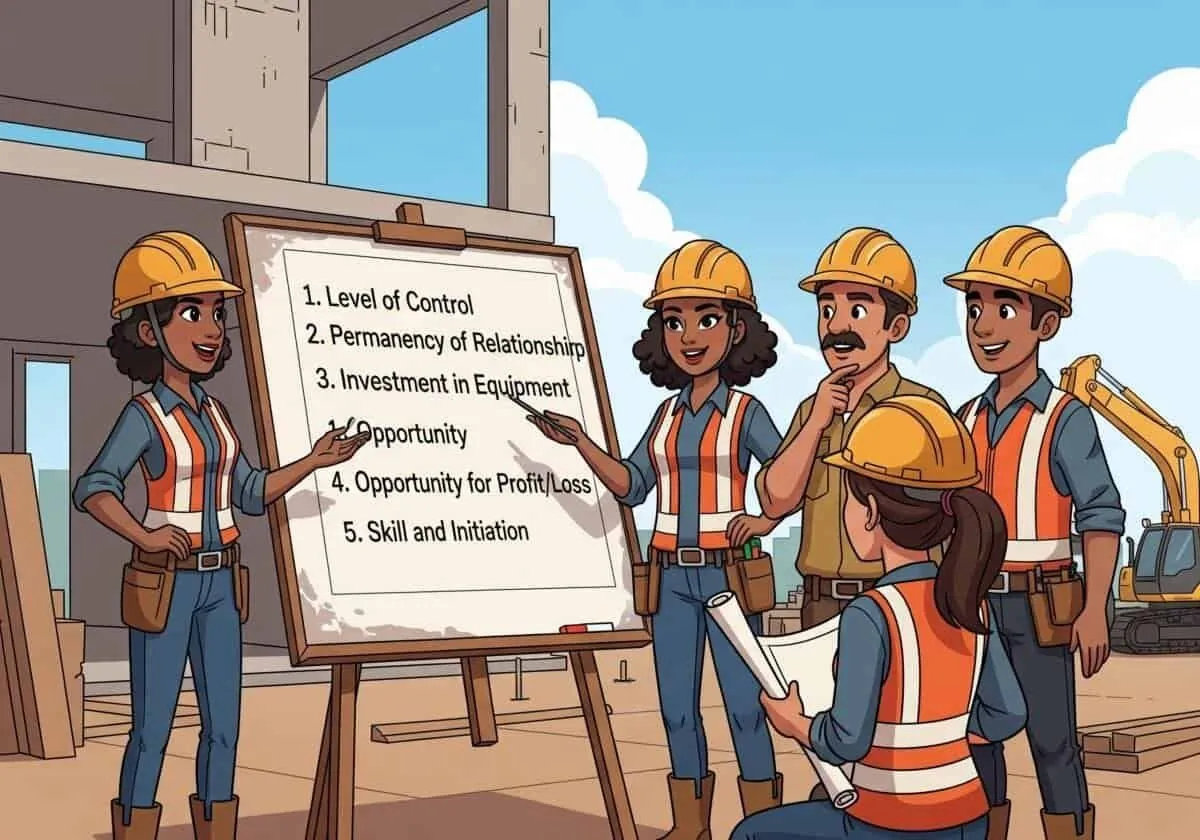
Employee or independent contractor: 5 warning signs
These signs help you see the risk. Agencies like the IRS, the EDD and the DIR use them to review each case.
1. You decide how, when and where the work is done
You tell them what time to arrive, what to do and how to do it. That looks like a job, not an independent business.
2. You use your own tools and equipment
An independent contractor normally brings their own tools. They also pay their own expenses.
3. You pay by the hour, day or week
A contractor usually charges per project or per invoice. A fixed weekly payment looks like a paycheck.
4. Does the main work of your business
If you are a drywall contractor and he installs drywall, he does the same work as your company.
5. Works only for you
If he has no other customers, no advertising and no license of his own, he does not have an independent business.
Signs are not conclusive proof
No single sign decides the case on its own. Agencies look at the whole working relationship. But if you see 3 or more signs, the risk is high.
That is why it pays to review each case carefully. Ask yourself how the work really runs day to day, not what the paper says.
California: The ABC Test
In California, a worker is presumed to be an employee. To treat the worker as a contractor, you must prove all 3 parts. The details are in the DIR guide.
| Part | What you must prove | Example in construction |
|---|---|---|
| A | Works free of your control and direction | He decides his own hours and method |
| B | His work is outside the normal line of your business | You are a roofer and you hire a graphic designer for your logo |
| C | He has an established business of his own in that trade | He has a license, insurance and other customers |
Part B is the hardest one in construction. If you do remodeling and hire someone to do remodeling, it almost never applies.
Licensed subcontractors (Labor Code 2781)
Construction has a special rule in Labor Code 2781. A subcontractor can be independent if they meet, among others, these requirements:
- The contract is in writing.
- He has a valid CSLB license in the job's classification.
- He has a registered business and a business location or address.
- They can negotiate and set their own prices.
- They can hire their own staff.
- He has or can get other customers.
- Controls their hours and the details of their work.
Read the full text of the law before you decide. If a subcontractor fails one of these points, ask for a review of their case.
If the worker has no license (Labor Code 2750.5)
In construction, if the job requires a license and the person doesn't have one, Labor Code 2750.5 presumes the person is an employee.
Example: you pay an unlicensed helper $200 a day and give him a 1099 at the end of the year. He is almost surely an employee. You should have paid him through payroll and had him on your workers' compensation (workers' comp) insurance.
What can happen if you classify wrong
- Paying back payroll taxes, with penalties and interest.
- Labor Code 226.8 penalties: $5,000 to $15,000 for each willful violation.
- From $10,000 to $25,000 per violation if there is a pattern.
- Paying overtime, breaks and other back wages.
- Penalties for not having workers' comp. Read workers' comp in California.
- Risk to your CSLB license.
For payroll deadlines and penalties, read payroll penalties. If you pay in cash, also check paying employees in cash.
When you switch to payroll, your payroll partners can help you with the process. Good records of payments in your bookkeeping books help you see who gets paid what.
Common mistakes when classifying workers
Many contractors make the same mistakes without realizing it. Almost all of them come from habit, not bad intent.
- Relying on the 1099: handing over the form doesn't change the real working relationship.
- Always paying the same amount per day, as if it were a salary.
- Giving a uniform, a fixed schedule, or a company truck to someone you call a contractor.
- Accepting a verbal agreement with a subcontractor, with no written contract.
- Not asking for the CSLB license or proof of insurance before starting.
Imagine you hire a helper for all your projects this season. He shows up when you say and uses your tools. Even if you call him independent, that relationship looks a lot like employment. This is an illustrative example.
How to document each person's classification
If an agency ever reviews your case, your paperwork helps explain your decisions. It doesn't guarantee a result, but it shows you reviewed the relationship carefully.
Keep a simple file for every person you pay. It should include:
- The written contract, with the scope of work and the payment terms.
- Copy of the CSLB license and current insurance, if applicable.
- Invoices the person sends you under their own business name.
- Notes on who decides the schedule, the method, and the tools.
Also record each payment in your bookkeeping (keeping your books up to date). This way you can clearly separate payroll from payments to subcontractors. With that separation, you quickly see who is paid per project and who is paid per day.
When it makes sense to move someone to payroll
If a person shows several signs of employment, the safest move is to review their case with a professional. A tax preparer or an employment attorney can guide you based on your situation. ODC doesn't provide those services, but it helps you keep your records organized for that conversation.
Switching to payroll means paying payroll taxes and carrying workers' comp. Plan for it before an audit comes, not after. It depends on your case and the current rules.
What to do now
- Make a list of everyone you paid with a 1099 this year.
- Next to each name, write down whether they have a CSLB license and insurance.
- Mark how many of the 5 signs each one meets.
- Review the risky cases with a professional.
FAQ
If we sign a 1099 contract, is he already a contractor?
No. What counts is what the working relationship is really like, not the paper they signed. If you direct the work, pay by the day and the person works only for you, he may be an employee even with a signed 1099.
Is a licensed subcontractor always a contractor?
Not always. He must meet the requirements of Labor Code 2781, such as having a valid license, his own business and a written contract, among others. If he fails any of them, he may be considered an employee. Check the text of the law or talk to a professional.
What is the ABC test?
It is the California rule that presumes a worker is an employee. The business must prove all 3 parts: A) free from control, B) work outside the usual course of business and C) an established business of their own. If even one part fails, the worker is treated as an employee.
When to talk to a professional
This article is a general guide. If your case involves a letter from the IRS, the FTB or the EDD, a lawsuit, an accident or a change in your business structure, talk to a lawyer, a tax preparer (CPA or enrolled agent) or the official agency. Every case is different.
How ODC helps you
At Oficina del Contratista we keep your bookkeeping up to date: we record your income and expenses, reconcile your accounts and explain your reports in Spanish. For taxes, payroll, insurance or legal matters, we connect you with independent partners; they provide those services, not ODC. See all services.
Questions about your 1099s? We organize your payments and connect you with partners. Message us on WhatsApp.
References
- IRS – Independent contractor or employee — Federal criteria for classifying workers
- EDD – Employment status — Employment status and the ABC test in California
- DIR – Independent contractor vs. employee FAQ — Frequently asked questions about independent contractors
- California Labor Code 226.8 — Penalties for intentional misclassification
- California Labor Code 2750.5 — Presumption of employee for unlicensed work in construction
- California Labor Code 2781 — Requirements for construction subcontractors

Runs Oficina del Contratista, a Spanish-language bookkeeping service for contractors. Has experience in management, sales and construction consulting.
Important notice: this article is educational and informational only; it is not legal or tax advice. It may contain errors or be out of date. Before making decisions, check it with a licensed expert or attorney.