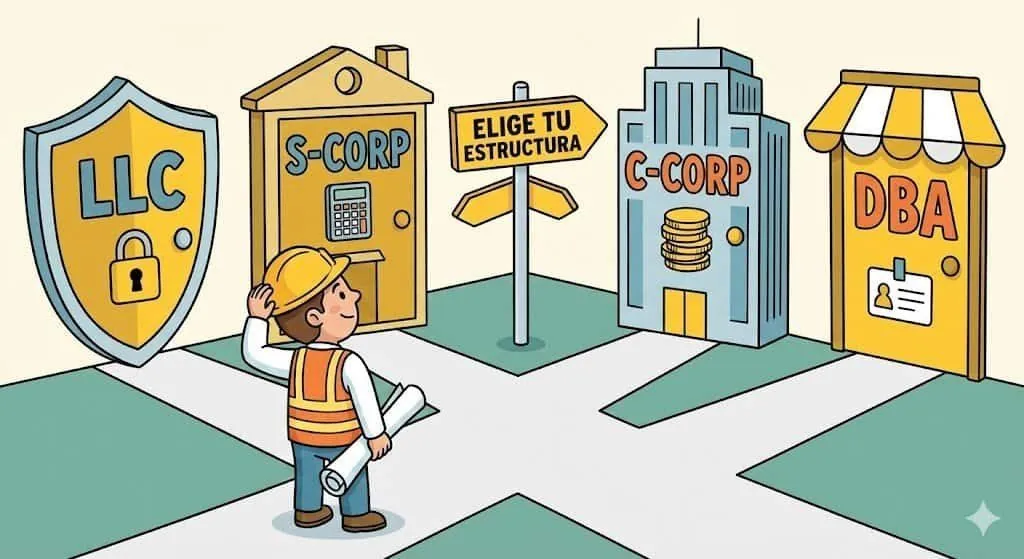
The corporate veil is the legal separation between you and your company. Thanks to it, if your LLC or corporation owes money, your personal assets are generally not on the line.
But that protection has limits. This guide explains when it protects you, when it doesn't and which habits keep it strong.
In short
- The corporate veil keeps the company's debts apart from your personal assets.
- A judge can ignore it under the alter ego doctrine if you mix your affairs with the company’s.
- If you sign a personal guarantee, you are responsible with your assets even if you have an LLC.
- Payroll taxes withheld from your employees can be collected from the owner personally.
- A separate account and organized records are your best defense.
What is the corporate veil?
When you form an LLC or corporation, a legal “person” separate from you is born. The company signs contracts, has accounts and owes money. You are the owner, but you are not the company.
This is called limited liability. If a customer sues your LLC over a job, in principle they can only collect from the LLC's assets. Your home and your savings stay out of it.
That shield exists from the moment you register the company. But it stays in place only if you treat the company as something separate. To learn what protects you, also look at the types of entities the state explains.
What California law says about alter ego
The alter ego doctrine lets a judge "pierce the corporate veil" and make you pay personally. It is a rule from California courts, not a filing you make. In general, judges look at two things:
- So much mixing between you and the company that you can't tell one from the other.
- That respecting the separation would produce an unfair result.
These signs are often used against you:
- Paying personal expenses from the business account.
- Having no company records or documents.
- Leaving the company without enough money to operate.
- Using the company to cheat creditors.
No single sign decides the case on its own. The judge looks at the whole picture. That is why it pays to take care of all of them, not just one.
LLC vs. corporation: differences in formalities
For an LLC, California law says that not holding formal meetings is not, by itself, a reason to apply alter ego (Corporations Code 17703.04). A corporation, on the other hand, must keep minutes, meetings and records (Corporations Code 1500).
In both cases, keeping your corporate record book up to date gives you proof that the company operates separately. To see what it should include, read corporate record book for LLCs and corporations.
Protects you / Does not protect you
| Situation | Does the LLC protect you? | Why |
|---|---|---|
| Normal business debts with suppliers | Yes, in general | The debt belongs to the company |
| Client lawsuit against the company | Yes, in general | The company and its insurance are responsible |
| Loan or credit backed by your personal guarantee | No | You signed as a person |
| Damage caused by your own negligence | No | You are responsible for your own actions |
| Payroll taxes withheld and not deposited | No | The IRS can collect from the responsible person directly |
| Mixed accounts and no records | Maybe not | Alter ego risk |
About payroll taxes: the money you withhold from your employees does not belong to the company. It belongs to them and the government. The IRS explains this rule in IRS – Trust Fund Recovery Penalty.
Example: the materials supplier
Say Jorge has a remodeling LLC. He opens a $40,000 credit line with a materials supplier. On the application, he also signs a personal guarantee. This is an example with made-up numbers to illustrate.
The LLC is in trouble and can't pay. The supplier can go after Jorge personally, even though the debt belongs to the LLC.
The LLC does not protect him on that debt because he agreed to guarantee it. Before you sign for credit, look for a “personal guarantee” section.
What the mix can look like in real life
Imagine Marta has a painting corporation. This is an illustrative example, not a real case. She pays for groceries, the family's gas, and her home rent with the business card.
Months later, a vendor sues the company. Their attorney reviews the account statements and sees personal expenses everywhere. That helps them argue there is no separation.
If Marta had paid her expenses with a recorded owner draw, the picture would be different. Clear records tell your story for you.
Habits that help keep the separation
- Use one bank account and one card only for the business.
- Always sign as “Name, Manager of XYZ LLC,” not just with your name.
- Record every owner's draw. Read how to pay yourself as an owner.
- Leave enough money in the company to operate.
- Put the important decisions in writing.
- Keep your insurance up to date. Read insurance and financing for contractors.
- File your Statement of Information on time. It is the report with the company's current information that you send to the Secretary of State. Find more details in the California Secretary of State FAQ.
A bookkeeping service helps make sure every expense and every withdrawal is recorded in its proper place. That leaves you with organized proof if anyone questions the separation.
What evidence helps show the company is separate
- Business statements with no personal expenses.
- Contracts signed in the company's name.
- A record of each owner contribution and each owner draw.
- Active insurance policies in the company's name.
No single test guarantees a result. A judge looks at the whole picture, and every case depends on its facts.
Common mistakes
- Paying your home rent from the LLC account.
- Signing contracts with your name and not the company's.
- Believing the LLC replaces insurance.
- Signing personal guarantees without reading them.
How to read a loan before you sign it
Before signing, ask for a copy of the contract and read it carefully. Look for words like “personal guarantee,” “guarantor,” or “jointly and severally liable.” They're signs that you are on the hook, and not just the company.
If you don't understand a clause, ask in writing or talk to a business attorney before you sign. ODC doesn't give legal advice, but it can help you organize your books.
What to do now
- Review your last 3 business statements and mark personal expenses.
- Find out which loans you signed with a personal guarantee.
- Check how you sign your contracts.
- Make sure your corporate record book is up to date.
FAQ
Does my LLC protect me if I sign a personal guarantee?
No. If you sign as a person guaranteeing a business debt, you are liable with your personal assets. The LLC protects only the debts the company takes on by itself. That is why you should read any "personal guarantee" section carefully before signing a credit line or a supplier contract.
What is the alter ego doctrine?
It is the rule that lets a judge ignore the separation between you and your company if interests are mixed and it would be unfair to respect it. If the judge applies it, you can be charged personally for an LLC debt. That is why it matters to treat the company as something separate.
If I mix accounts, do I lose the protection?
Not automatically, but it is one of the most common arguments used against you. The judge looks at the whole set of signs, like records, enough money and how the company is used. Keep a bank account and a card for the business only, and write down every owner withdrawal.
When to talk to a professional
This article is a general guide. If your case involves a letter from the IRS, the FTB or the EDD, a lawsuit, an accident or a change in your business structure, talk to a lawyer, a tax preparer (CPA or enrolled agent) or the official agency. Every case is different.
How ODC helps you
At Oficina del Contratista we keep your bookkeeping up to date: we record your income and expenses, reconcile your accounts and explain your reports in Spanish. For taxes, payroll, insurance or legal matters, we connect you with independent partners; they provide those services, not ODC. See all services.
Want to review the separation between your company and your assets? We connect you with legal partners and organize your books. Message us on WhatsApp.
References
- California Corporations Code 17703.04 — Alter ego and formalities in an LLC
- California Corporations Code 1500 — Books and records of a corporation
- CA Secretary of State – Business entities FAQ — Questions about LLCs, corporations and the Statement of Information
- CA Secretary of State – Types of business entities — Entity types and limited liability
- IRS – Trust Fund Recovery Penalty (TFRP) — Withheld payroll taxes and personal liability

Runs Oficina del Contratista, a Spanish-language bookkeeping service for contractors. Has experience in management, sales and construction consulting.
Important notice: this article is educational and informational only; it is not legal or tax advice. It may contain errors or be out of date. Before making decisions, check it with a licensed expert or attorney.