Taxes for contractors in California depend on your structure, how much you earn and whether you have employees. The goal is not to pay less at any cost, but to pay what is fair, on time and with records to back it up.
This guide explains the most common taxes, the key dates and which documents to keep.
In short
- If you work for yourself, you pay self-employment tax of 15.3% on your net profit if it is $400 or more.
- Taxes are paid during the year with 4 estimated payments, not just in April.
- In California, LLCs and corporations pay a minimum tax of $800 a year to the FTB.
- If you have employees, there are also federal and EDD payroll taxes.
- Without records, it is hard to defend your expenses; keep them at least 3 years.
California taxes for contractors: the ones that usually apply
Not all of them apply to everyone. Your tax preparer, CPA or enrolled agent confirms which ones apply to you.
Self-employment tax (tax for working for yourself)
It is Social Security and Medicare for people who work for themselves. The rate is 15.3%: 12.4% for Social Security and 2.9% for Medicare. It applies if your net profit is $400 or more (source: IRS).
Say your net profit for the year is $60,000. The math is done on 92.35% of that amount, or $55,410. Self-employment tax would be about $8,478, on top of income tax.
Federal and state income tax
It is calculated on your profit, not on your sales. That is why every business expense you record correctly matters. You pay it to the IRS and to the Franchise Tax Board (FTB), California's tax agency.
$800 minimum tax to the FTB (LLCs and corporations)
In California, LLCs and corporations pay a minimum annual tax of $800 to the FTB, even if they didn't make money (source: FTB). LLCs with more than $250,000 in gross income also pay a fee based on their income.
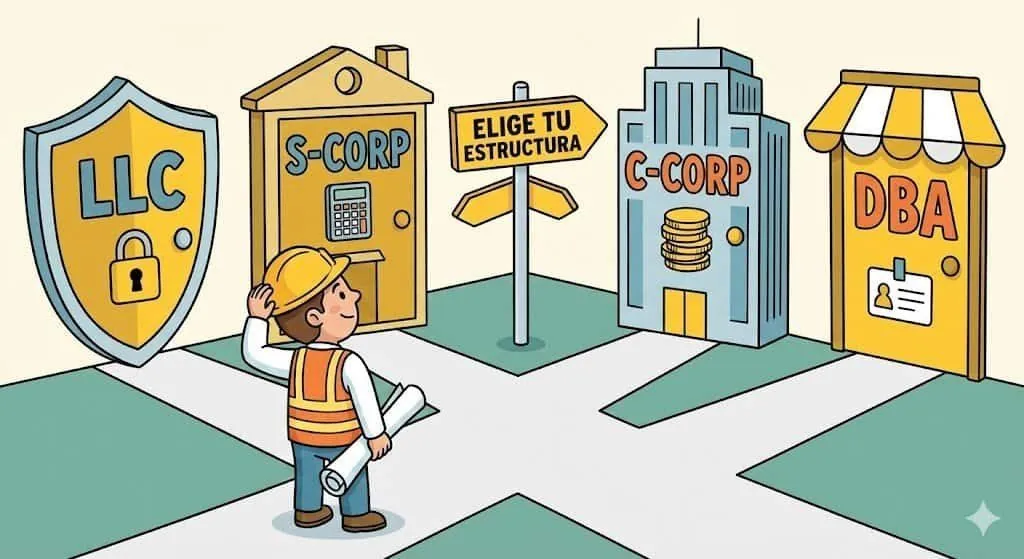
To compare structures, read LLC, S-Corp, C-Corp or DBA: which fits a contractor.
California payroll taxes, if you have employees
You must withhold and deposit federal taxes: income tax, Social Security and Medicare (source: IRS). You must also register and pay payroll taxes to California's Employment Development Department (EDD) (source: EDD).
If you deposit late, there are penalties. Read our guide to payroll penalties.
Sales tax and use tax
In many construction contracts in California, the contractor is treated as the consumer of the materials they install. You pay the tax when you buy them and you don't charge it separately to the customer.
There are exceptions, for example with certain fixed equipment. If you don't need a seller's permit but you have $100,000 or more in gross receipts a year, you must register with the CDTFA for a use tax account (CDTFA Publication 9).
Estimated taxes for contractors: the 4 dates you can't forget
If no one withholds taxes for you, you must pay them during the year. These are estimated taxes: payments in advance, not one payment in April. Here is how federal payments and California payments work.
| Payment | Federal (Form 1040-ES) | California (Form 540-ES) |
|---|---|---|
| 1 | April 15 | 30% on April 15 |
| 2 | June 15 | 40% on June 15 |
| 3 | September 15 | 0% in September |
| 4 | January 15 of the following year | 30% on January 15 |
If the date falls on a weekend or holiday, it moves to the next business day. Check the dates every year with the IRS and the FTB.
If you do not pay on time, the IRS and the FTB can charge penalties and interest. A late payment in June counts too, even if you pay everything in April.
Gross income vs. net income
Gross income is everything you collected. Net income is what is left after you subtract your business expenses. You pay taxes on the net.
If you do not record an expense, you pay too much in taxes. If you record an expense without a receipt, you can lose it in an audit.
An example with made-up numbers: you collect $150,000 in a year. You spend $90,000 on materials, subcontractors and the truck, with receipts. Your net profit is $60,000, and your taxes are figured on that number.
Which tax records to keep and for how long
The IRS asks you to keep your records for as long as it can review your return. In general that is 3 years, and 4 years for payroll records (source: IRS).
| Document | What it is for | Suggested time |
|---|---|---|
| Customer invoices and deposits | Check your income | 3 years minimum |
| Receipts for materials and expenses | Check your deductions | 3 years minimum |
| Payroll records | Employment taxes | 4 years |
| Equipment and vehicle purchases | Depreciation and future sale | As long as you have them, plus 3 more years |
| Tax returns | History | Indefinite, recommended |
The risk of paying cash with no record
Paying in cash with no record is not a saving. You lose the deduction for that expense and you risk payroll penalties.
Without a receipt or payroll, you cannot prove what you paid. Read paying employees in cash: risks.
Bookkeeper and tax preparer
The bookkeeper puts your income and expenses in order every month. The tax preparer uses those books to file your return and plan.
If your books arrive organized, the preparer can help you pay only what you owe. At ODC we keep the books with our bookkeeping service. Taxes are prepared by independent partners.
What to do now
- Open a bank account just for taxes.
- Every time you get paid, move a fixed percentage there.
- Mark the 4 estimated payment dates on your calendar.
- Ask your preparer to confirm how much to set aside.
FAQ
How much should I set aside for taxes?
It depends on your case. Many contractors set aside between 25% and 30% of their net profit. Your tax preparer can calculate a more exact percentage based on your income, your structure and whether you have employees. What matters is to set it aside every time you get paid, not at the end of the year.
What happens if I don't pay estimated taxes?
The IRS and the FTB can charge a penalty and interest for underpayment, even if you pay everything when you file your return. If you are already behind, ask your tax preparer to review your case before the next due date. Paying something on time is usually better than paying nothing.
Do I have to pay sales tax as a contractor?
In many construction contracts in California, the contractor is treated as the consumer of the materials and pays the tax when buying them. If you don't need a seller's permit but you have $100,000 or more in gross income a year, you must register with the CDTFA for a use tax account. Check Publication 9.
When to talk to a professional
This article is a general guide. If your case involves a letter from the IRS, the FTB or the EDD, a lawsuit, an accident or a change in your business structure, talk to a lawyer, a tax preparer (CPA or enrolled agent) or the official agency. Every case is different.
How ODC helps you
At Oficina del Contratista we keep your bookkeeping up to date: we record your income and expenses, reconcile your accounts and explain your reports in Spanish. For taxes, payroll, insurance or legal matters, we connect you with independent partners; they provide those services, not ODC. See all services.
Want your records ready for your tax preparer? Message us on WhatsApp.
References
- IRS – Self-employment tax — 15.3% rate and the $400 threshold
- IRS – Estimated taxes — Federal estimated payment dates (Form 1040-ES)
- FTB – Estimated tax payments — California estimated payment percentages and dates (Form 540-ES)
- FTB – Business entities — $800 minimum tax and LLC fee
- CDTFA – Publicación 9, Construction and Building Contractors (PDF) — Contractor as a consumer of materials; use tax
- IRS – Recordkeeping — How long to keep records: 3 years, 4 years for payroll

Runs Oficina del Contratista, a Spanish-language bookkeeping service for contractors. Has experience in management, sales and construction consulting.
Important notice: this article is educational and informational only; it is not legal or tax advice. It may contain errors or be out of date. Before making decisions, check it with a licensed expert or attorney.