You are about to open your construction business, or you already work for yourself. Someone tells you "get an LLC," another says "an S-Corp is better," and another says "a DBA is enough." Whom do you listen to?
This guide is for contractors and business owners in California. It explains in plain words what each option is. It is informational and is not legal or tax advice. The decision is best made with an attorney and a tax preparer, CPA, or enrolled agent.
In short
- An LLC and a corporation are entities registered with the state. A DBA is just a trade name and does not create an entity or legal protection.
- S-Corp is not a type of company: it is a tax election with the IRS that a qualifying LLC or corporation can make.
- In California, LLCs and corporations pay a minimum annual tax of $800 to the FTB, plus other possible charges.
- If you do not comply with the state, your company can be suspended, and that can affect contracts and your contractor license.
- No structure is the best for everyone. It depends on your case.
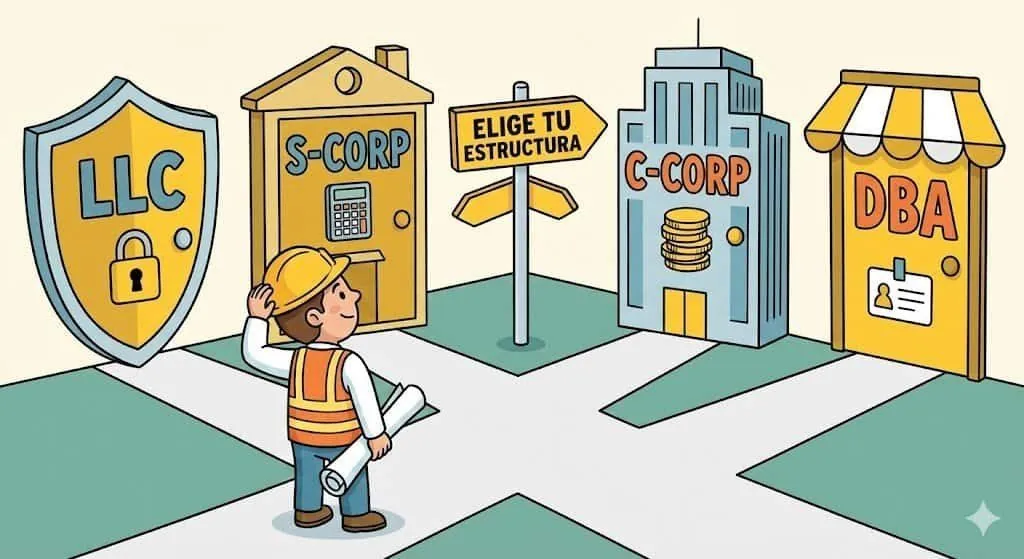
Differences between LLC, S-Corp, C-Corp, and DBA
These options sound alike, but they change two important things: how you pay taxes and how separate your personal assets are from the business.
DBA (Doing Business As)
A DBA, or fictitious business name, is a trade name. In California it is registered with the county (the county clerk's office) and it usually has to be published in a newspaper. Deadlines are set by each county and it is generally renewed every five years.
A DBA does not create a separate company. If you operate as a sole proprietor with a DBA, you and the business are the same person in the eyes of the law. A lawsuit or a business debt can reach your personal assets.
LLC (limited liability company)
An LLC is formed by registering it with the California Secretary of State. It is designed to separate the business from the owner. In general, this helps protect your personal assets from business debts.
That protection is not absolute. It can be lost, for example, if you mix personal and business money, if you do not keep your documents up to date or if you signed a personal guarantee. Your attorney can explain the limits.
According to the IRS, an LLC with one owner is treated by default as part of the owner for income tax, and one with several owners is treated as a partnership. It can also choose to be treated as a corporation.
C-Corp (C corporation)
It is a separate entity that pays taxes on its profits. The IRS explains that if it later pays out dividends, the shareholder also pays taxes on them. This is called double taxation.
S-Corp (tax election)
The IRS describes the S-Corp as an election made with Form 2553. With it, profits pass through to the owners and are reported on their personal returns. There are requirements, such as the type and number of shareholders and a single class of stock.
Many people choose it to reduce self-employment tax. But the savings are not automatic. The owner who works in the business must receive a reasonable salary through payroll, and payroll comes with costs and paperwork. The IRS watches to make sure distributions do not replace that salary.
In California, an S-Corp also pays a state tax on its profit, with a minimum of $800, according to the FTB.
LLC or DBA: which protects more
Example: a remodeling contractor works under a DBA. A client sues him over poorly done work. Since a DBA is not a separate entity, the lawsuit can go after him personally.
With a well-run LLC, a claim normally goes against the company. But the LLC does not replace your liability insurance or your contractor bond.
An LLC also tends to give a more formal image with banks and clients. That is not a tax advantage by itself.
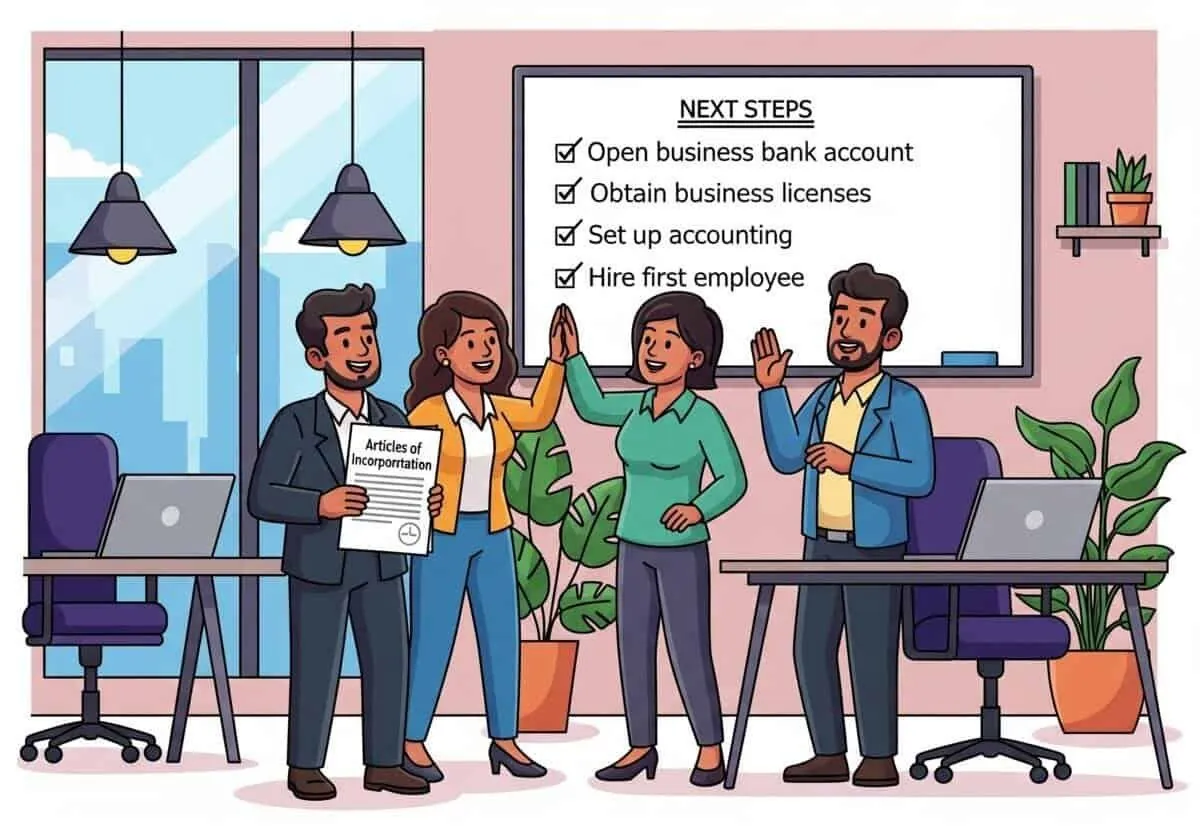
Basic steps to form your company
- Register the LLC or corporation with the Secretary of State (SOS). This is how the entity is born.
- Get an EIN from the IRS. It is your company's identification number. You will use it for the bank, taxes, and payroll.
- Prepare the internal documents. For example, the LLC operating agreement and the corporate record book with minutes.
- Open a bank account just for the business.
- Review your contractor license and your insurance. If you already have a license, ask the CSLB how a change of structure affects it.
Opening a bank account does not mean you are up to date on all your documents. Read more about the corporate record book for an LLC in California.
$800 annual tax and other charges in California
LLCs and corporations in California must pay the FTB a minimum annual tax of $800. The FTB explains how to file it depending on the type of business.
Some points worth knowing:
- The first-year exemption that existed for LLCs formed between 2021 and 2023 has ended. For new businesses, confirm with the FTB whether you have to pay in the first year.
- LLCs with income of $250,000 or more may owe an additional fee based on their income.
- If the LLC elects to be treated as an S-Corp or C-Corp, the calculation changes. Ask your tax preparer.
Amounts and dates may change. Always verify them on the FTB website.
Suspension of an LLC or corporation in California
The SOS requires a Statement of Information periodically. The FTB requires returns and payment of the annual tax. If you do not comply, your company can be suspended.
The FTB states that while a business is suspended, its contracts may be voidable, meaning the other party could cancel them. There is a process to request relief and reinstate it.
For a company with a contractor license, the law provides that the CSLB will suspend the license if the entity is not current with the SOS and the FTB, after giving notice (Business and Professions Code, section 7510.3). Check your case with the CSLB or an attorney.
There may also be other effects, such as not being able to sue or defend yourself in court. A lawyer can explain which ones apply to you.
What to do now
- Write down what structure you have today and how the IRS and FTB treat it.
- Ask your tax preparer whether an S-Corp makes sense at your profit level.
- Put the dates for California's annual tax and the information return on your calendar.
- Check your company's status with the SOS and the FTB, and your license status with the CSLB.
- Keep your documents in one place: operating agreement, minutes, EIN, and records.
When to talk to a professional
Talk to an attorney before forming the company or signing an operating agreement. Talk to a tax preparer, CPA, or enrolled agent before choosing S-Corp or changing your structure. LLC formation and legal filings are handled by independent partners, not ODC.
How ODC helps you
Once your company is formed, we make sure your books stay up to date. Learn about our bookkeeping for contractors service and our protection for your business page.
References
- IRS: S corporations — what the S-Corp election is and its requirements.
- IRS: LLC filing as a corporation or partnership — tax classification of an LLC.
- IRS: Business structures — comparison of structures and C-Corp double taxation.
- California FTB: My business is suspended — effects of suspension and how to reinstate.
- California Secretary of State: Business entities — how LLCs and corporations are registered.
- California FTB: Business filing information — annual tax and returns.
This article is for information and education only. It is not legal, tax or bookkeeping advice. We are a bookkeeping service: for tax matters, consult a tax preparer, CPA or enrolled agent.
Do you want to know how your business is really doing?
Message us or call us. We answer in Spanish, no strings attached.
Message us on WhatsAppThis article is for information only and is not a substitute for legal advice.