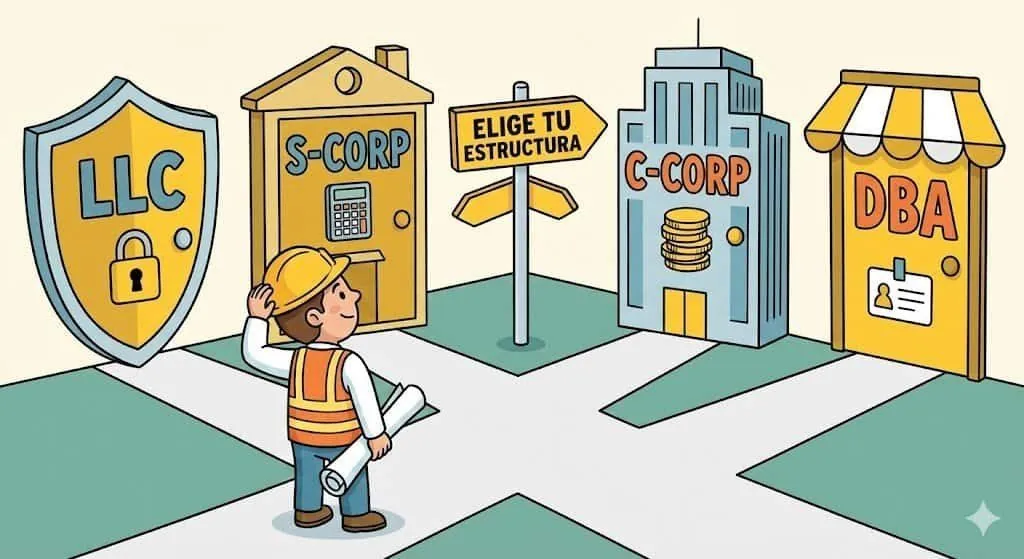
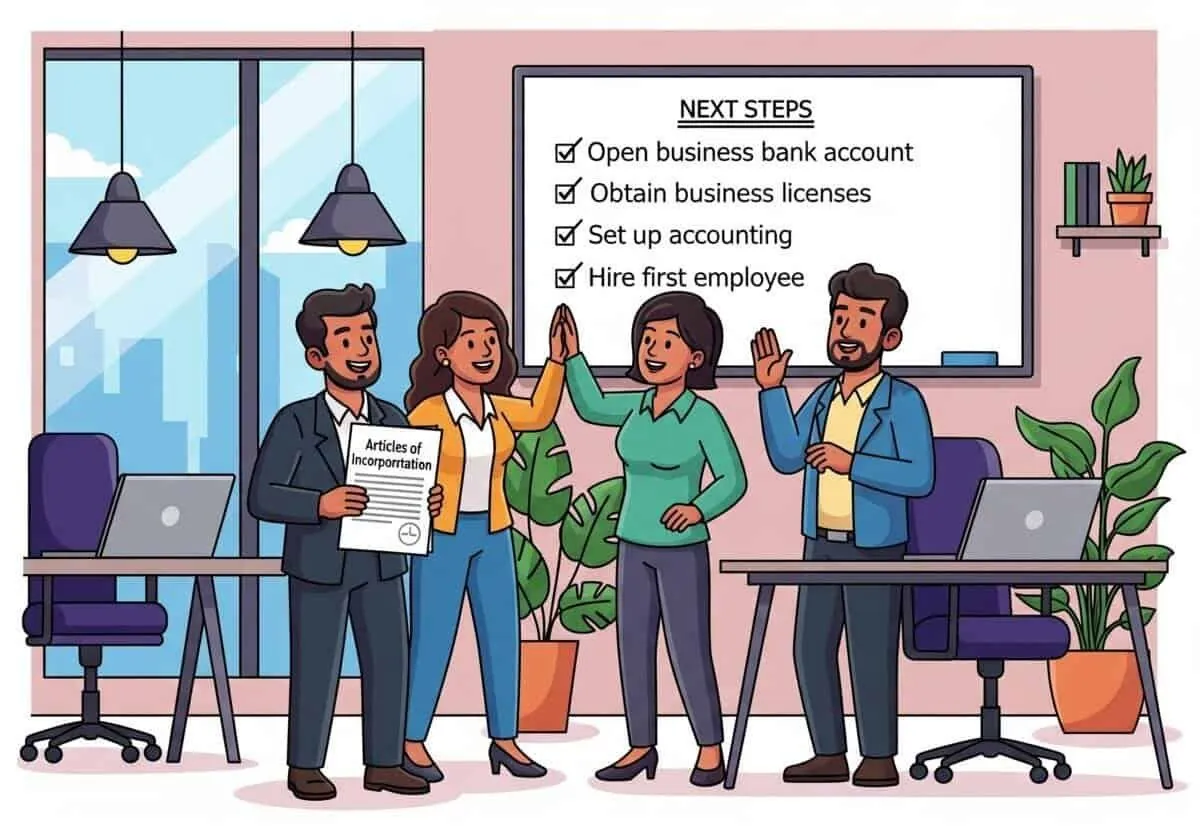
You already have your LLC or corporation. The approval from the State arrived, and now the question comes up: what's next? Many contractors start working and miss filings that later turn out costly, like an overdue report or a mixed account.
This checklist is for construction business owners in California who have just formed their company. It explains the first steps in order, what reports each type of entity files, and what to watch out for with your brand.
In short
- First: keep your formation documents, get your EIN if you need it, and open a bank account just for the business.
- Reporting frequency differs: the LLC files the Statement of Information every two years and the corporation every year.
- Forming the company does not give you a license or insurance: those are separate steps.
- The name registered with the State does not protect your brand nationwide; the federal registration with the USPTO does that.
- With employees come EDD obligations, workers' compensation insurance, and rules about contracts.
Step 1: save your formation documents and put together your book
Gather the articles of organization or incorporation and the operating agreement (LLC) or bylaws (corporation). These are the rules of your business: who decides, how profits are shared, and who signs.
Keep them in a digital folder with a backup. We explain the details in the corporate records book guide.
Step 2: EIN and business bank account
The EIN is your business's identification number with the IRS. Not every LLC needs one: according to the IRS, a single-member LLC with no employees or special taxes can use its owner's number. It does need one if it hires employees, if the bank asks for it, or if it has more than one member or is a corporation.
Next, open a bank account just for the business. The bank usually asks for the formation documents, your ID, and the EIN, if you have one. Avoid using your personal account to get paid or to pay for the company.
If you used a personal account for work, start recording everything in the new account from the formation date. Ask your bank what documents they accept.
Step 3: licenses and permits to operate
Forming the company creates the entity. It does not give you permission to work. In construction, the CSLB has its own requirements for LLCs (qualifier, bonds, and insurance), and corporations have theirs. There may also be city or county licenses.
Check with the CSLB and your city to see what you need before signing contracts. Permits depend on your activity and location.
Step 4: Periodic Reports by Entity Type
The paperwork does not end when you form the company. This changes depending on your entity (California Secretary of State):
| Topic | LLC | Corporation |
|---|---|---|
| Statement of Information | First within 90 days and then every two years (Form LLC-12) | First within 90 days and then every year (Form SI-550) |
| FTB tax | Annual LLC tax (Form 3522) | Minimum franchise tax, based on your return |
| Minutes and meetings | Only if your operating agreement requires them; it is wise to document major decisions. | The law requires minutes and a shareholder register; there is an annual meeting |
The Statement of Information fee and the tax amount change over time, so confirm them with the Secretary of State and the FTB. Put the dates on your calendar: the State sends reminders, but the obligation is yours.
Your tax preparer, CPA, or enrolled agent will tell you which federal and state returns apply to your entity.
Step 5: protect your brand with the USPTO
Registering your company with the State lets you use a name as an entity, but it does not give you trademark rights. According to the USPTO, a state registration protects only in that state, and a federal registration creates nationwide rights for the goods or services you list.
The USPTO does not enforce your trademark or notify you of infringements. Before applying, do a search to see whether someone already uses a similar name. An intellectual property attorney can help you.
Step 6: employees, contractors, and insurance
- EDD. If you pay more than $100 in wages in a quarter, you must register as an employer within 15 days (EDD). See how professional payroll helps you.
- Workers' compensation. If you have employees, California requires this insurance (DIR/DWC). The CSLB license also requires proof, unless you qualify for an exemption for having no employees.
- Employee or independent contractor. The name of the contract does not decide it. Read our 5 points to know if someone is an employee.
- Non-compete agreements. In California, they are generally void for employees. Before using a template from another state, consult an employment attorney.
- General liability. The company separates your assets, but it does not replace insurance. Talk to an agent based on your risks.
Step 7: contracts in the company name, website, and social media
Sign contracts, loans, and quotes with the exact name registered with the State and the CSLB. Use the same name on your website and social media so customers and banks can identify you easily.
A simple website with your license, your services, and photos of jobs helps people contact you. It is not a legal requirement, but it is part of starting right.
What to do now
- Keep your formation documents and note whether you have an LLC or a corporation.
- Decide with your tax preparer whether you need an EIN and apply for it on the official IRS website.
- Open the business bank account and stop mixing expenses.
- Check what license and insurance the CSLB requires for your type of entity.
- Put the date of your Statement of Information and the FTB tax on your calendar.
- Search for your name in the USPTO database before investing in a logo and signs.
When to talk to a professional
This article is informational and is not legal or tax advice. Consult an attorney for the operating agreement, bylaws, trademark, and employee contracts. Consult a tax preparer, CPA, or enrolled agent for the EIN, taxes, and the S-Corp election. For licenses, go to the CSLB.
FinCEN announced in 2025 that companies formed in the U.S. are exempt from reporting owners (BOI). The rules have changed several times, so confirm the current status at fincen.gov.
How ODC helps you
At Oficina del Contratista we keep your books up to date (bookkeeping) from the first month, so your money is organized from the start. Learn about bookkeeping for contractors and our business consulting. Entity formation, taxes, and legal matters are handled by independent partners.
References
- California Secretary of State: Business entities FAQs — periodic reports and Statement of Information.
- USPTO: Why register your trademark? — federal registration versus business name and state registration.
- California DIR/DWC: Employer information — workers' compensation insurance.
- IRS: Single member limited liability companies — when an EIN is needed.
- EDD: Register as an employer — employer registration in California.
- CSLB: Licenses for Limited Liability Companies — license requirements for LLCs.
This article is for information and education only. It is not legal, tax or bookkeeping advice. We are a bookkeeping service: for tax matters, consult a tax preparer, CPA or enrolled agent.
Do you want to know how your business is really doing?
Message us or call us. We answer in Spanish, no strings attached.
Message us on WhatsAppThis article is for information only and is not a substitute for legal advice.